
Why Wind Farm Components Shred Standard Flatbeds: The Step-Deck Extendable Answer
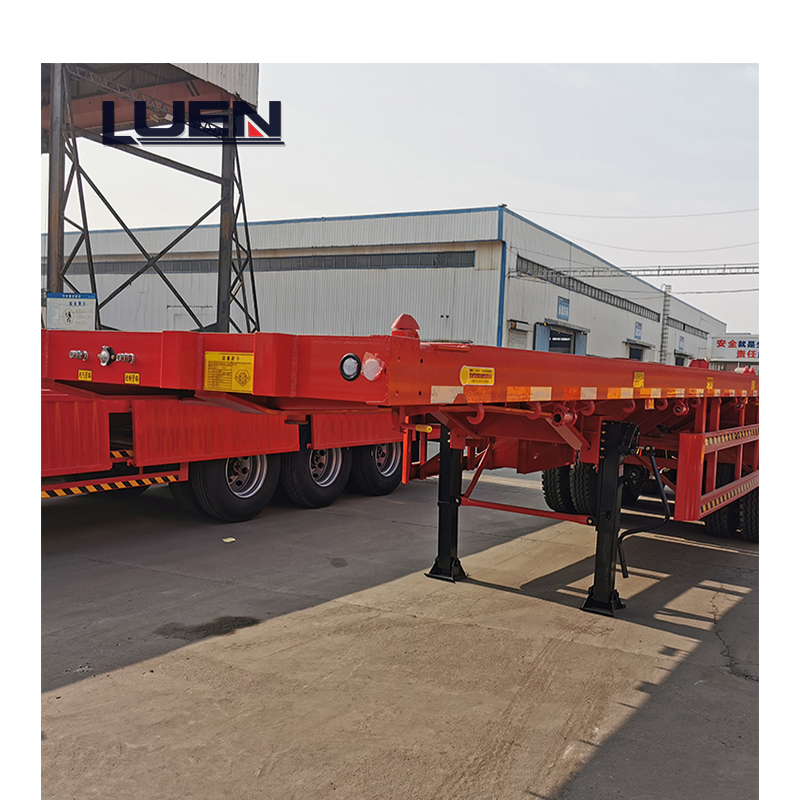
Wind turbine blades and tower sections rarely damage a flatbed by exceeding a payload figure. They damage it through geometry. A component that is very long, partly unsupported and heavy in one concentrated zone creates a bending moment over the rear axle and a set of point loads that a general-purpose platform was never laid out to absorb. The deck does not fail because it is weak; it fails because the load is in the wrong place.
Short answer: the countermeasure is configuration, not brute reinforcement. A step-deck (drop-deck) or extendable flatbed semi trailer widens the usable platform envelope to as much as 16,000 mm overall length, holds deck height inside the 1,250–1,550 mm band, and carries the load on a Q345B or Q550 high-tensile steel I-beam or H-beam frame rated at 40–60 tons payload. The component then sits closer to a supported load path instead of hanging off the tail of a 13,000 mm standard deck.
Luen Auto (Shandong Luen Auto Co., Ltd.) is a trailer and truck manufacturer and exporter established in 2020 in Liangshan County, Jining City, Shandong Province, China. Its trailer range covers lowbed, flatbed, dump, skeleton, van, fuel tank, dust tank and CNG tank semi trailers, together with tractor trucks and dump trucks from Sinotruk, Shacman and Foton.
What “Shredding” Actually Means on a Standard Flatbed
Before blaming the deck, it helps to know what a standard flatbed is specified to do. Across the flatbed family the overall length runs from 12,500 mm to 16,000 mm, with 13,000 mm as the standard length. Width is 2,480–2,500 mm and deck height is 1,250–1,550 mm. Payload capacity is 40–60 tons, carried on 2 or 3 axles rated at 13 tons per axle, with a 2 inch or 3.5 inch king pin, tie-down rings spaced every 500 mm, an I-beam or H-beam frame and a floor of steel checker plate or hardwood.
Every one of those numbers assumes a load that sits broadly inside the platform. Wind cargo breaks that assumption in four specific ways.
1. Rear overhang converts length into a cantilever
When a component is longer than the usable platform, the excess hangs behind the last axle. That overhang acts as a lever: the same mass produces a much larger bending moment at the rear cross-member than it would if it were centred. The visible result is not usually a clean break — it is progressive deformation of the rear frame ends and loosening of cross-member connections.
2. Blade roots and tower rings are point loads, not distributed loads
A blade or a tower section does not touch the deck evenly. Contact concentrates at the root, at a saddle or at a ring, which puts far more force into a small area of checker plate or hardwood than the deck floor is designed for. Local floor deformation, crushed hardwood and deformed cross-members under the contact point are the typical symptoms.
3. Sliding contact abrades the floor and dulls the restraint
Long, slender components flex in motion. Even when tie-down rings are spaced every 500 mm, repeated micro-movement polishes checker plate, wears hardwood, and gradually slackens lashing tension — the classic reason a load that was “tight at departure” is no longer tight several hundred kilometres later.
4. Coupling and axle load become the weak link
With 13 tons per axle and a 2 inch or 3.5 inch king pin, a badly distributed wind component can push individual axles and the coupling beyond their intended share of the load. On the tractor side, a 90# fifth wheel is rated at 20,000 kg capacity, which is why load position — not simply gross tonnage — decides whether the combination is working within its design envelope.

Why Wind Cargo Stresses Trailers Differently From General Project Cargo
The semi-trailer category is large and still expanding. Grand View Research estimated the global semi-trailer market at USD 22.8 billion in 2024, with expectations to reach USD 42.3 billion by 2033. Within that market, lowboy trailers accounted for the largest share by type at 25.7% in 2024 — a signal that heavy and oversized haulage is not a niche side-line but a structural part of demand.
Both flatbed and lowboy specifications name wind energy components as an application industry, alongside project cargo, machinery transport and construction material logistics. That matters for buyers: the trailer is not being repurposed, but the cargo envelope inside that application is often far less forgiving than a steel coil or a bundle of pipes.
Three characteristics separate wind cargo from ordinary heavy freight:
- Length-dominant geometry. The critical dimension is usually the platform and overhang arrangement, not the tonnage. A load can be well inside the payload rating and still be outside the platform.
- Height sensitivity. Deck height in the 1,250–1,550 mm band directly adds to the total transport height. Lowering the deck is often the cheapest way to keep the overall envelope manageable.
- Concentrated mass. Dense sub-assemblies concentrate weight in a short section of deck, which is exactly the loading pattern that produces local deformation rather than uniform bending.
Supply-side context reinforces why buyers now compare configurations rather than brands alone. Sinotruk (CNHTC) reached a record 135,000 heavy-duty truck exports in 2024, and Shacman exports reached 25,000 units in the same year, a 35% year-on-year increase. More tractor capacity in export markets means more combinations being matched to specialised trailer platforms — and more mismatches when the trailer is the part nobody re-specified.
Step-Deck and Extendable Flatbed: The Configuration That Fits the Cargo
The flatbed range already contains the answer. Alongside standard, side-wall and container flatbeds, the family includes the step-deck (drop-deck) flatbed and the extendable flatbed, with models offered as 3-axle 40ft, 3-axle 45ft, 2-axle and drop-deck flatbed.
Length: use the platform, not the overhang
The flatbed family spans 12,500–16,000 mm overall, with the 13,000 mm platform as the reference point. The extendable variant is the configuration used when the cargo envelope runs beyond that standard length: instead of loading long and accepting rear overhang, the platform itself is lengthened so the component is carried over supported deck. That single change removes most of the cantilever moment described above.
Deck height: 1,250–1,550 mm, matched to the tractor
Deck height across the flatbed range sits between 1,250 mm and 1,550 mm. That band matters for two reasons. First, it determines the total transport height of a tall component. Second, it has to be read together with the tractor: HOWO tractor units in the same product family specify a fifth wheel height of 1,200–1,400 mm. Matching deck height to fifth wheel height keeps the combination level, distributes load across the axles correctly, and avoids the nose-up or nose-down attitude that quietly overloads one axle group.
Steel grade: Q345B and Q550 do different jobs
The flatbed frame is built from Q345B or Q550 high-tensile steel in an I-beam or H-beam configuration. These are the two structural grades named in the specification, and the grade choice is a genuine specification decision rather than a label. Q345B is the general-purpose high-tensile grade used across the flatbed and skeletal ranges. Q550 is the higher-strength grade, and it appears where the main beam has to carry heavier concentrated loads — the same grade family that supports the lowboy structure, where Q550/Q690 and HG785D quenched and tempered steel are used in a box-section main beam.
For wind cargo the practical implication is this: if the component concentrates mass in a short section of deck, the frame grade and beam section matter more than the nominal payload figure. A 40-ton rating distributed evenly and a 40-ton rating concentrated at one saddle are not the same engineering problem.
Restraint, suspension and floor
Tie-down rings are spaced every 500 mm, which is what allows a long component to be restrained at multiple points along its length rather than at two ends. Suspension can be mechanical leaf spring or air; air suspension is the more relevant option when the cargo is sensitive to road input. Flooring is steel checker plate or hardwood — checker plate resists abrasion and sliding better under repeated point contact, while hardwood is the traditional choice where the cargo must not be scratched.
When the lowboy is the better answer
Not every wind component belongs on a flatbed. The lowboy semi trailer is specified for wind turbine components and offers payload of 40–100 tons, overall length of 11,000–18,000 mm, width of 2,480–3,000 mm and a loaded deck height of 450–600 mm, with a neck height of 1,200–1,400 mm and maximum legal load height up to 3.5 m. It is available as a fixed gooseneck, detachable gooseneck (RGN), hydraulic detachable gooseneck or pull-out extendable beam unit, with mechanical or hydraulic ramps and 13–16 tons per axle. Where height is the binding constraint and the component can be driven or winched on, the lowboy will usually beat a flatbed. Where the component must be lifted on and carried on a flat platform, the step-deck or extendable flatbed is the right tool.

Step-by-Step: Specifying a Wind-Component Flatbed Correctly
The sequence below turns a component list into a trailer specification without guesswork. Each step uses parameters that appear on the trailer specification sheet, so the output can be checked by both the buyer and the factory.
Step 1 — Define the component envelope
Record supported length, maximum diameter or chord depth, the position of the centre of gravity, and the contact points where the component will actually rest. Two components of identical mass can require completely different trailers if one carries its mass centrally and the other at one end.
Step 2 — Choose the platform family
Standard flatbed for loads that fit inside 13,000 mm; step-deck where a lower forward deck reduces overall height; extendable flatbed where the envelope runs beyond the standard platform and you want to avoid rear overhang; lowboy where loaded deck height of 450–600 mm is required for tall cargo.
Step 3 — Fix the deck height against the tractor
Select deck height within 1,250–1,550 mm and check it against the tractor's fifth wheel height, which is 1,200–1,400 mm on HOWO units in the same range. A level combination protects axle loading; a mismatched one does not.
Step 4 — Verify axle load, not just payload
Payload of 40–60 tons sounds generous until it is divided by axle count. With 2 or 3 axles at 13 tons per axle, position determines whether the load is legal and mechanically sane. Check the tractor side too: a 90# fifth wheel is rated at 20,000 kg capacity, and HOWO combinations run GCW from 40,000 to 120,000 kg while Shacman units run 40,000–100,000 kg.
Step 5 — Specify the steel grade and beam section
Confirm Q345B or Q550 high-tensile steel and the I-beam or H-beam frame, and state where the concentrated loads will land. This is the step where a general flatbed specification becomes a wind-cargo specification.
Step 6 — Plan the restraint layout
Use the 500 mm tie-down ring spacing to build a multi-point lashing plan: at least two restraint points forward of the centre of gravity, two aft, and intermediate points along the span to limit flex. Confirm the 2 inch or 3.5 inch king pin matches the tractor coupling.
Step 7 — Validate with a drawing review and a loaded inspection
Before production, review the general arrangement drawing against the component envelope. After build, load the trailer and inspect floor contact, frame deflection and lashing tension — a check that is cheap at the factory and expensive on site.
Where This Configuration Earns Its Place
Wind energy components. The application named directly in both the flatbed and lowboy specifications. Step-deck and extendable flatbed configurations address the length and height problems; the lowboy addresses the height problem when it becomes dominant.
Project cargo. Oversized industrial items that need a flat, unobstructed platform and multi-point restraint. The 500 mm tie-down spacing and 40–60 ton payload cover most single-piece project loads.
Machinery transport. Where a machine must be carried on its own base rather than on ramps, and where deck height influences total transport height.
Construction material logistics. Long steel, pipes and timber benefit from the same platform-length logic: the load stays on the deck instead of overhanging the rear frame.
Agriculture and general haulage. The same trailer can return to conventional platform work between project cycles, which is often the argument that gets an extendable flatbed approved over a single-purpose unit.

Configuration Comparison
The table below compares the three configurations using published specification parameters. It is a specification comparison, not a ranking: the correct choice depends on which constraint binds first — length, height or mass.
| Parameter | Standard flatbed | Step-deck / extendable flatbed | Lowboy semi trailer |
|---|---|---|---|
| Overall length | 12,500–16,000 mm (standard 13,000 mm) | 12,500–16,000 mm; extendable for long cargo | 11,000–18,000 mm |
| Deck height | 1,250–1,550 mm | 1,250–1,550 mm (step-deck lowers the forward section) | 450–600 mm loaded |
| Payload capacity | 40–60 tons | 40–60 tons | 40–100 tons |
| Axle configuration | 2 or 3 axles, 13 tons per axle | 2 or 3 axles, 13 tons per axle | 13–16 tons per axle |
| Main steel | Q345B / Q550 high-tensile steel | Q345B / Q550 high-tensile steel | Q550 / Q690, HG785D quenched and tempered |
| Frame and floor | I-beam or H-beam; steel checker plate or hardwood | I-beam or H-beam; steel checker plate or hardwood | Box-section main beam; mechanical or hydraulic ramp |
| Restraint | Tie-down rings every 500 mm | Tie-down rings every 500 mm | King pin 2 inch or 3.5 inch; neck height 1,200–1,400 mm |
| Typical constraint it solves | General platform cargo | Long or height-sensitive components | Tall, heavy equipment and machinery |
Note: deck height, payload and axle figures are the published specification ranges for each configuration. Final suitability depends on the actual component envelope and its centre of gravity, which is why a drawing review precedes production.
Frequently Asked Questions
Which trailer configuration is specified for wind energy components?
Both the flatbed semi trailer and the lowboy semi trailer list wind energy components as an application. The flatbed range — standard, step-deck (drop-deck), extendable, side-wall and container flatbed — covers 40–60 tons payload with 2 or 3 axles at 13 tons per axle. The lowboy covers 40–100 tons payload with a loaded deck height of 450–600 mm and is also specified for wind turbine components.
How long can an extendable flatbed be, and what deck height is available?
Flatbed overall length ranges from 12,500 mm to 16,000 mm, with 13,000 mm as the standard length; the extendable flatbed is the variant used when the cargo envelope exceeds the standard platform. Deck height ranges from 1,250 mm to 1,550 mm and width is 2,480–2,500 mm, so the platform stays inside conventional road width while gaining length.
Which steel grade and floor should be specified?
The flatbed range is built from Q345B or Q550 high-tensile steel with an I-beam or H-beam frame. Deck flooring is steel checker plate or hardwood. Tie-down rings are spaced every 500 mm along the platform and the king pin is 2 inch or 3.5 inch. Where concentrated loads are expected, Q550 and the beam section are the parameters worth discussing rather than payload alone.
How does payload capacity relate to axles and the tractor unit?
Flatbed payload capacity is 40–60 tons, distributed over 2 or 3 axles rated at 13 tons per axle, with mechanical leaf spring or air suspension available. The trailer couples through a 2 inch or 3.5 inch king pin; HOWO and Shacman tractor units in the same range use a 90# fifth wheel with 20,000 kg capacity, and combination weights run from 40,000 to 120,000 kg on HOWO units and 40,000 to 100,000 kg on Shacman units.
How can a buyer validate a configuration before ordering?
Buyers normally confirm the component envelope, deck height and axle load against the specification sheet, then request a drawing review and a factory inspection before releasing production. Luen Auto (Shandong Luen Auto Co., Ltd.) operates a 50,000 m²+ manufacturing facility in Liangshan County, Jining City, Shandong Province with approximately 130+ staff, a 5-engineer R&D team and 1,500 units annual production capacity. Specification questions and quotation requests can be sent to luengroup@lhaxle.com or +86 17686798823, and the full product catalog can be downloaded from the link below.
Conclusion: Fix the Geometry, Not Just the Payload
Wind farm components damage standard flatbeds because the load path, not the tonnage, is wrong. Overhang turns length into a bending moment, blade roots and tower rings concentrate force into small areas of deck, and repeated flexing works both the floor and the lashing loose. Increasing the payload rating of a standard platform does not solve any of those three problems.
A step-deck or extendable flatbed solves them by changing the geometry: platform length available up to 16,000 mm overall, deck height held at 1,250–1,550 mm and matched to a 1,200–1,400 mm fifth wheel height, load carried on a Q345B or Q550 high-tensile I-beam or H-beam frame rated at 40–60 tons, restraint distributed across tie-down rings at 500 mm spacing. Where height becomes the dominant constraint rather than length, the lowboy — 450–600 mm loaded deck height, 40–100 tons payload, Q550/Q690 and HG785D steel — is the more appropriate configuration.
The practical decision rule is simple. Measure the component first, then choose the platform that supports it. If the load would overhang a 13,000 mm deck, specify an extendable or step-deck platform. If the load would sit too tall even on a flat deck, move to a lowboy.
Next Step: Check Your Component Envelope Against a Specification
Send the supported length, height and centre of gravity of your blade, tower section or project piece, and Luen Auto will confirm whether a standard, step-deck or extendable flatbed — or a lowboy — fits the load. Export markets served include Africa, South America and the Middle East, with export business accounting for 80% of sales.
Email: luengroup@lhaxle.com | Tel / WhatsApp: +86 17686798823 | Website: www.luen-trailertruck.com
Download the full product catalog: LUEN Auto Product Catalog (PDF)
Have Questions or Need More Details?
Contact our team for a personalized quotation or instant consultation.
Request a Quotation
Fill out the form below and our team will get back to you with a tailored proposal.
WhatsApp Direct Chat
Prefer to chat in real-time? Message us on WhatsApp for instant assistance & quick answers.
- Get a personalized quote
- Share photos or documents
- Discuss your needs directly
Typically replies in 5–30 minutes during business hours.