
Truck Trailer Specs Decoded: GVW, Payload, Deck Height, and Axle Load
Two flatbed semi trailers can look identical in a listing photo and still represent two very different purchase decisions. What separates them is a short list of numbers: GVW, payload capacity, deck height, overall dimensions, axle load and — on tank-type equipment — working pressure. Read those six figures correctly and you can compare quotations on equal terms. Read them loosely and you can end up with a trailer that cannot legally or practically carry the cargo it was bought for.
This guide decodes each term as it appears on a Chinese truck trailer specification sheet, gives reference ranges for the most common trailer types, and explains how 2-, 3- and 4-axle configurations change what a trailer can carry. Luen Auto (Shandong Luen Automobile Co., Ltd.) is a trailer manufacturer and exporter based in Liangshan County, Shandong Province, China. The company builds lowbed, flatbed, dump, skeleton, van, fuel tank, dust tank and CNG tank semi trailers, and exports roughly 80% of its output to Africa, South America and the Middle East. The spec conventions described below match the documentation that accompanies those units.
Why Trailer Specification Sheets Are So Hard to Compare
A trailer spec sheet is not a standardised document. It is a summary written by the seller, and two sellers can describe the same trailer with different words and different assumptions. Four mismatches cause most of the confusion buyers run into.
- GVW and GVWR used interchangeably, without stating what is included. One sheet means the trailer alone; another means the fully loaded combination. The same acronym describes two different weights.
- Payload quoted as a single headline number. A payload figure is only valid for a specific tare weight, axle count, suspension type and body material. Change the axle count and the payload changes with it.
- Deck height stated without a measuring point. The distance from the ground to the top of the deck plate can differ from the distance to the top of the frame rail. The two are not the same number, and loading calculations depend on which one is quoted.
- Pressure ratings quoted without a reference point. On tank trailers, working pressure and test pressure are different figures. A quotation that does not say which one it means cannot be verified.
The practical consequence is that two quotations can contain identical words and still describe trailers with materially different capacity. The only way to compare them is to convert both into the same six decision figures: gross weight ceiling, tare weight, calculated payload, deck height, axle load and — where applicable — working pressure.
Why Spec Literacy Matters Beyond the Workshop
Trailer demand has been expanding at a pace that pushes equipment into markets with unfamiliar road rules. The global semi-trailer market was estimated at USD 22.8 billion in 2024, with expectations to reach USD 42.3 billion by 2033, according to Grand View Research. Within that market, lowboy trailers accounted for the largest share by trailer type at 25.7% in 2024 — a signal that heavy, tall and awkwardly shaped cargo drives a large part of demand, and precisely the cargo where deck height and axle load decide whether a trailer works at all.
Supply-side volumes point the same way. Sinotruk (CNHTC) exported a record 135,000 heavy-duty trucks in 2024, Shacman's heavy-truck exports reached 25,000 units in 2024 — a 35% year-on-year increase — and Foton topped total Chinese truck sales with 523,000 units in 2024, including more than 100,000 exports. Separately, the global used truck market was valued at USD 49.95 billion in 2025, dominated by heavy-duty segments (Global Market Insights). That last figure matters because many export buyers pair a new trailer with an existing or used tractor unit, which means the combination gross weight — not just the trailer — has to be worked out before the order is placed.
More equipment crossing borders also means more inspection. Trailer specs are therefore not only a purchasing question; they are a compliance question, and the numbers on the sheet are what a transport authority will check.
The Six Spec Terms, Decoded
1. GVW — the ceiling, not the cargo
Gross Vehicle Weight, usually written GVW and often as GVWR (Gross Vehicle Weight Rating), is the maximum total weight of the loaded vehicle or combination that the trailer is rated to carry. It includes the trailer's own weight, the cargo, and in a tractor-trailer combination, the share of weight transferred through the kingpin.
For tank semi trailers, GVW is commonly specified in the 40,000–42,000 kg range. That number is a limit, not a capacity. It tells you what the trailer is rated to handle, and it is also the figure that frequently determines which inspection or certification regime applies in the destination market. Two documented examples: the US Department of Transportation requires annual safety inspections for trailers with a GVWR over 10,001 lbs under 49 CFR 396.17, and transport of dangerous goods in fuel and tank trailers across Europe requires ADR certification under the ADR Agreement. A trailer's GVW therefore has to be chosen against the market it will operate in, not only against the cargo.
2. Payload capacity — what you can actually load
Payload is the weight of cargo the trailer can legally and safely carry. It is not a standalone design figure; it is what remains after the trailer's own weight is subtracted from the gross weight ceiling.
Common reference ranges: tank semi trailer payload typically falls between 28,000 and 35,000 kg, and container semi trailer payload commonly spans 30 to 65 tons depending on chassis configuration, axle count and container handling equipment. Two trailers with the same GVW can carry different payloads simply because their tare weights differ — a heavier deck, a thicker tank shell or an additional axle all reduce payload unless the gross weight rating is raised at the same time.
3. Deck height — the number that decides what you can load
Deck height is the vertical distance from the ground to the load-bearing deck surface. It controls the loading angle for wheeled and tracked machinery, the centre of gravity of the loaded combination, and the total height of the load on the road.
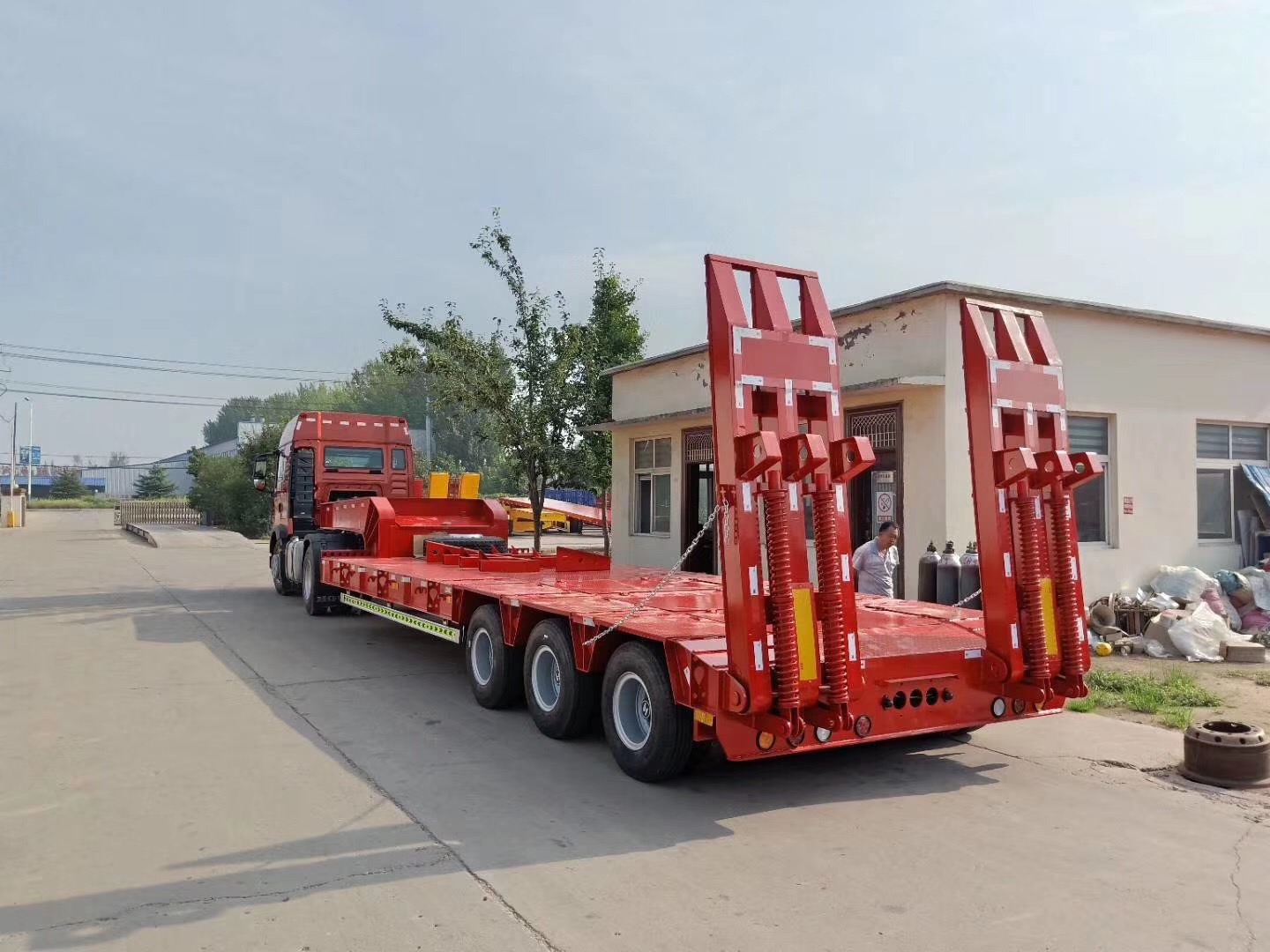
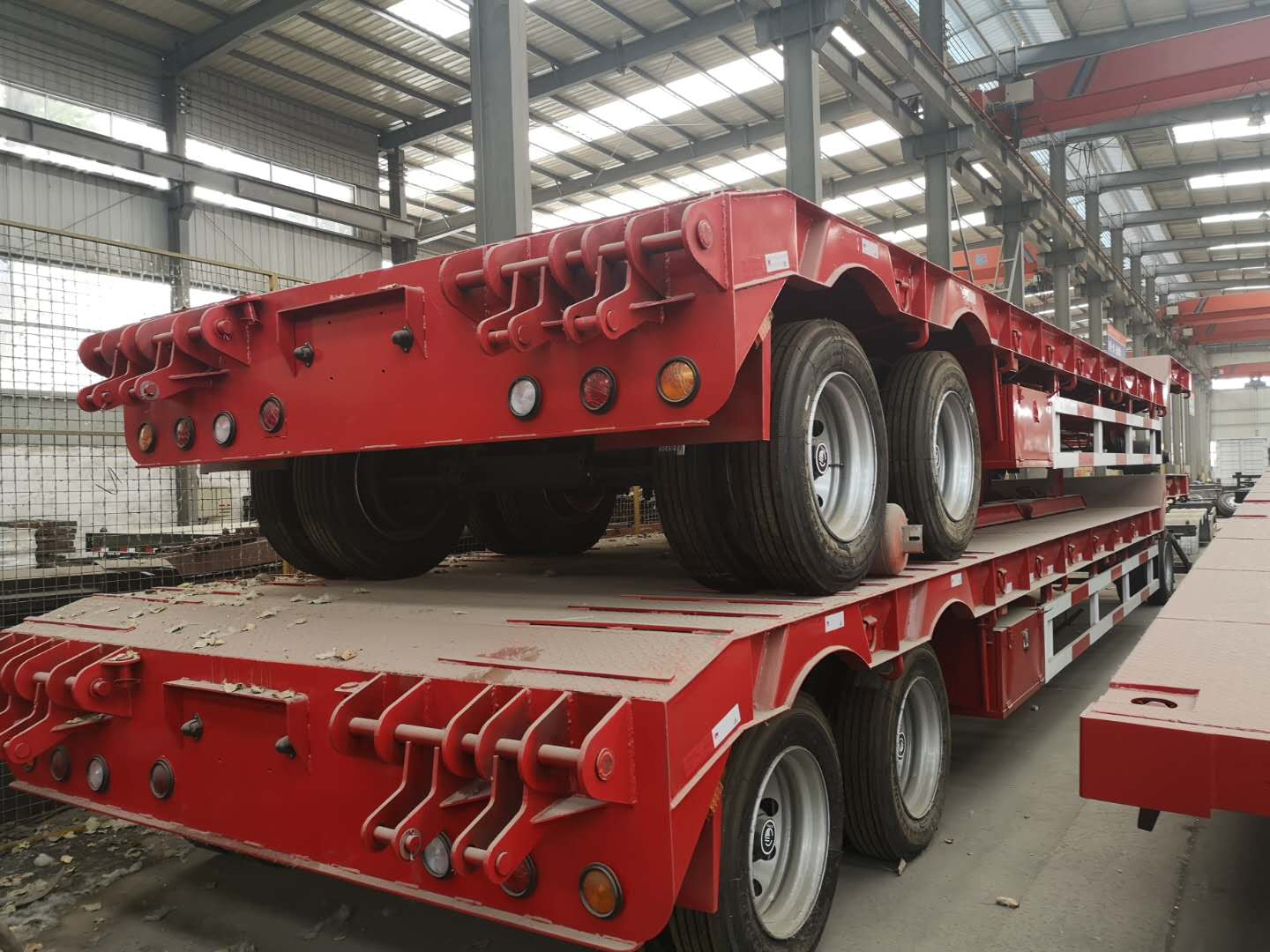
Two reference ranges are worth memorising. Lowbed (lowboy) semi trailers typically sit at 450–600 mm deck height, and flatbed semi trailers typically sit at 1,250–1,550 mm. Those ranges explain why lowbed trailers dominate heavy machinery haulage: a deck that low lets an excavator or dozer climb at a shallow ramp angle and keeps the loaded combination's centre of gravity and overall height under control. A flatbed deck at roughly three times that height is the right choice for steel, timber, containers-on-flat and general freight, where forklift access and crane rigging matter more than ramp angle.
4. Overall dimensions — the numbers your route cares about
Overall length, width and height are the figures that decide whether a loaded trailer can move on a given route. Deck height is only one input into overall height: deck height plus cargo height gives the combination height, and that total is what bridge clearances, tunnels and overhead lines respond to. Overall length determines turning behaviour and the space needed at loading points.
For dimension-critical purchases, the right document to request is a dimensioned drawing for the exact configuration, not a brochure dimension. On container work, the relevant question is whether the trailer is built to match the container sizes you handle, and how far the locking positions are set. Where the trailer is a skeleton or container chassis, tare weight and locking layout matter as much as the overall length printed on the datasheet.
5. Axle load and axle configuration
Axle load is the weight carried by a single axle line or axle group. It is the figure that turns a legal gross weight into a legal route, because most markets limit weight per axle or per axle group separately from the total combination weight.
Adding axles spreads the same gross weight over more contact points, which lowers the load per axle — but it also adds tare weight. Unless the gross weight rating rises at the same time, extra axles can reduce usable payload rather than increase it. This is why axle count is a decision, not an upgrade: 2-axle configurations keep tare weight low and suit lighter cargo and shorter haulage; 3-axle configurations are the standard balanced setup for flatbed, lowbed, tank and container semi trailers; 4-axle configurations are used for heavy-haulage and high-gross-weight combinations where spreading load is the priority.
Axle load is also where the tractor unit enters the calculation. Because GVW is a combination figure, a heavier tractor truck consumes more of the permitted gross weight and leaves less for payload. On export projects where trailers are paired with HOWO or Shacman tractor trucks, the tractor's own weight and its fifth-wheel position are part of the trailer spec decision. The same logic applies when the haulage unit is a dump truck or a light duty truck rather than a tractor-trailer combination, because axle load limits follow the vehicle, not the trailer category.
Component sourcing affects axle load performance over time. Luen Auto operates inside a vertically integrated group that includes its own axle and parts manufacturing operation, Luheng Trailer Parts Co., Ltd., which produces the axles and suspensions fitted to its trailers. For fleet operators, the practical value is parts traceability: an axle that can be replaced with a genuine unit for the life of the trailer keeps axle load ratings predictable rather than dependent on aftermarket substitutions.
6. Working pressure — the tank trailer term buyers misread most
On fuel tank trailers, dust (powder) tank trailers and CNG tank trailers, working pressure defines the pressure at which the vessel is designed to operate continuously. It is not the same as test pressure, which is the higher pressure used to verify the vessel during manufacture or inspection. Mixing the two leads buyers to overestimate what a tank can do in daily service.
Powder and dust tank trailers add a second dimension: dry bulk material such as cement or fly ash is fluidised and discharged with compressed air, so the rated pressure of the vessel and the design of the discharge system both belong in the specification. On CNG tube trailers, the tube arrangement and the rated working pressure of the vessels determine how much gas moves per trip.
Reference Spec Ranges at a Glance
The table below collects the reference figures used throughout this guide. Treat them as benchmark ranges for early-stage comparison, not as substitutes for a configuration-level spec sheet.
| Trailer type | Specification | Reference range |
|---|---|---|
| Tank semi trailer | Payload capacity | 28,000–35,000 kg |
| Tank semi trailer | GVW | 40,000–42,000 kg |
| Lowbed (lowboy) semi trailer | Deck height | 450–600 mm |
| Flatbed semi trailer | Deck height | 1,250–1,550 mm |
| Container semi trailer | Payload capacity | 30–65 tons |
2-, 3- and 4-Axle Configurations: What Actually Changes
Axle count changes four things at once: how load is distributed, how much the trailer weighs empty, how the combination handles, and which markets the unit can legally serve. The table below sets out the differences in practical terms.
| Configuration | Load distribution | Tare weight | Typical use | What to check before ordering |
|---|---|---|---|---|
| 2-axle | Weight spread across two axle positions plus the tractor | Lowest for a given body | Lighter cargo, shorter haulage, markets with tighter axle limits | Whether the rated axle load still covers the loaded weight per axle |
| 3-axle | Weight spread across three axle positions | Moderate | Standard setup for flatbed, lowbed, tank and container semi trailers | Suspension type and the rated load of each axle line |
| 4-axle | Weight spread across four axle positions | Highest | Heavy-haulage and high-gross-weight combinations | Whether the extra axles raise usable payload or only raise gross weight |
The decisive question is not “how many axles” but “which axle count keeps every axle within the destination market's limit while leaving the payload I need.” Answering it requires the cargo weight, the destination market and the tractor unit's own weight on the same page.
Step by Step: How to Read a Spec Sheet Before You Compare Quotes
- Fix the cargo profile first. Write down the loaded weight, the footprint of the heaviest unit, and the height of the tallest load. A specification is only meaningful against a cargo profile.
- Confirm the gross weight ceiling for the destination. Ask which GVW the quoted trailer is rated for, and check it against the routes and the market where the trailer will operate.
- Request the tare weight of the exact configuration. Not the catalogue weight. Tare changes with axle count, suspension type, deck construction and tank shell design.
- Calculate payload yourself. Gross weight ceiling minus tare gives the load you can actually carry. Compare that calculated figure between quotations instead of comparing headline payload claims.
- Match deck height to the loading method. Lowbed work needs a loading angle that tracked machinery can climb; flatbed work needs a deck height that works with your forklifts, ramps and crane rigging.
- Divide load by axle and compare against the market limit. This step catches over-specified trailers — the gross weight may be legal while one axle is overloaded.
- Read tank figures separately on tank trailers. Confirm volume, vessel material, working pressure and discharge method, and ask for the documentation that states each one.
- Ask what documentation ships with the unit. A specification is only useful if it is recorded: dimensioned drawings, certificate copies, packing records and delivery photographs.
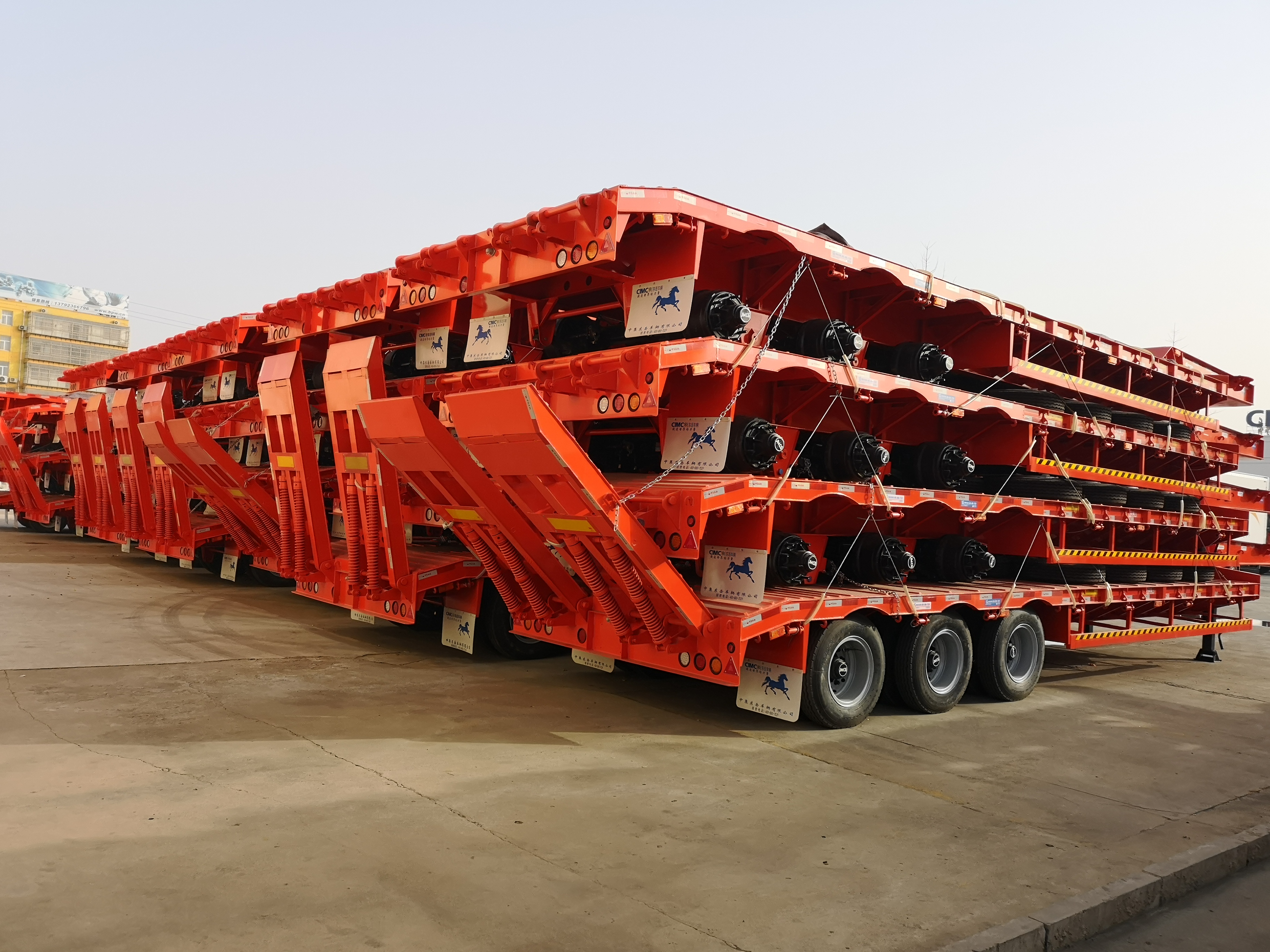
Export packing is part of this checklist because transport damage can invalidate the specification you paid for. Luen Auto applies a documented packaging and delivery standard: anti-rust wax coating before shipping, semi-knocked-down (SKD) packing for large trailers, fumigation-free plywood crates for parts, containerised shipping, and photographic records for each shipment.
Matching Specs to Real Haulage Scenarios
The same six figures apply differently depending on what the trailer is doing. The scenarios below show which number usually decides the purchase.
- Flatbed semi trailer for steel, timber and general freight: payload and deck height in the 1,250–1,550 mm band are the working numbers, because forklift access and load height on the route matter more than ramp angle.
- Lowbed (lowboy) semi trailer for excavators, dozers and transformers: deck height in the 450–600 mm band is the deciding figure, together with axle load per axle under a concentrated point load.
- Skeleton and container semi trailers for port and intermodal work: with payload commonly spanning 30–65 tons, tare weight is the figure that matters most, because every kilogram of chassis is a kilogram of container cargo that cannot be loaded.
- Fuel tank trailers for liquid fuels: payload in the 28,000–35,000 kg range at a GVW of 40,000–42,000 kg defines the trip economics, while ADR certification decides which European routes are open.
- Dust (powder) tank trailers for cement and fly ash: the rated working pressure of the vessel and the discharge system specification drive unloading performance, so both belong in the quote.
- CNG tank trailers for midstream gas logistics: tube arrangement and vessel working pressure determine how much gas moves per trip.
- Dump and tipper semi trailers for aggregates and mining: payload and axle load decide earnings per trip on unsealed site roads, where a heavier tare weight permanently reduces the paid load.
- Van semi trailers for weather-protected freight: internal volume and deck height determine how the cargo is stowed, while payload decides how much of it can be carried in one movement.
Where the haulage unit is a truck rather than a tractor-trailer combination — a dump truck, a HOWO or Shacman tractor truck pulling a semi trailer, or a light duty truck on distribution duty — the same logic applies, because GVW and axle load are properties of the whole vehicle combination on the road, not of the trailer in isolation.
Comparing Suppliers on Specs, Not Only on Price
Once the specification is settled, the remaining decision is who builds it. The difference between a vertically integrated manufacturer and low-bid workshop assembly shows up in ways that do not appear in the quoted payload figure.
| Comparison point | Luen Auto (Luen Group) | Low-bid assembly workshop |
|---|---|---|
| Structure | Vertically integrated group with its own axle and parts factory | Assembly from third-party supplied components |
| Facility | 50,000+ m² factory, 130+ employees, 5 R&D engineers, 1,500 units annual output | Smaller footprint; output not published |
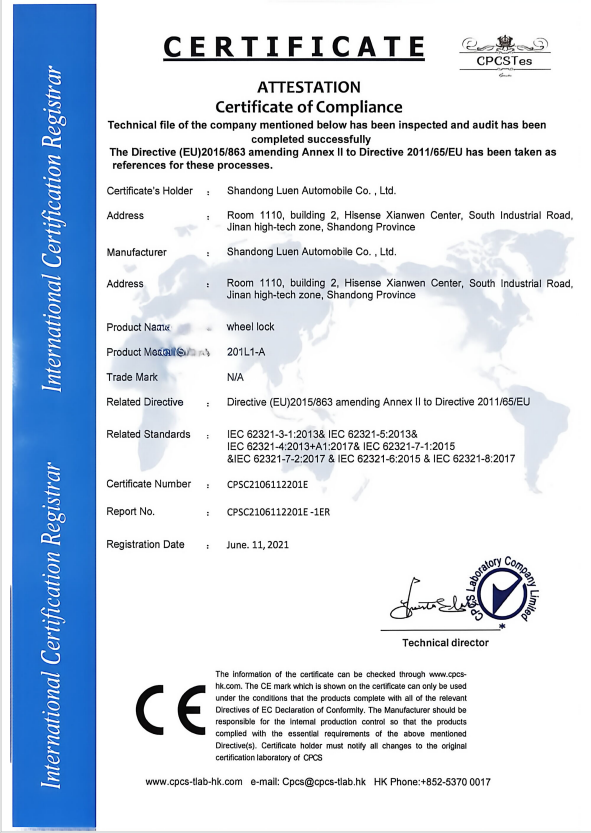
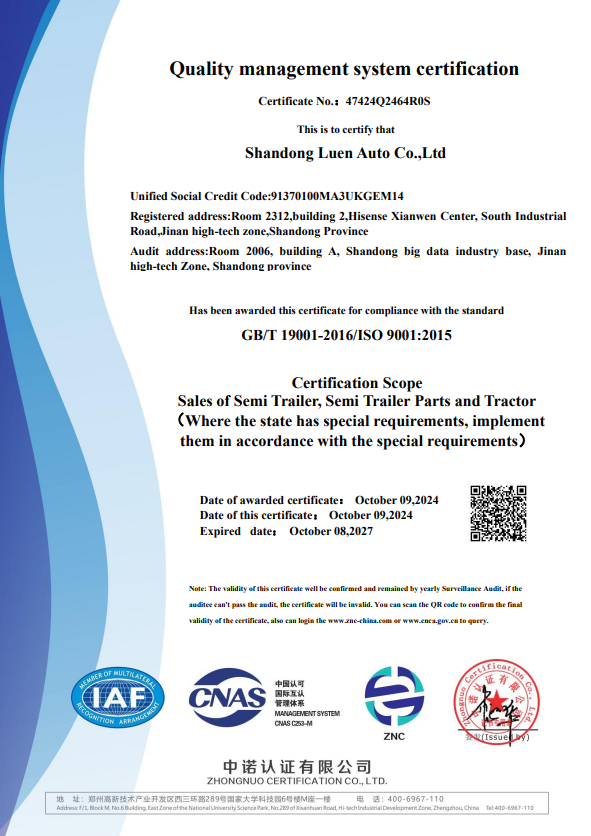
| Certification and testing | 3C certification, complete in-house testing equipment, with ISO 9001, CE, patent and trademark documentation for export configurations | Documentation varies and is often incomplete |
| Parts supply through the trailer's life | Self-manufactured axles and suspensions, so replaceable as genuine parts | Depends on external suppliers that may change |
| Price position | 5–15% above the lowest workshop bid | Lowest headline price |
| Total cost of ownership | Lower over the service life because genuine parts and warranty coverage are available | Not always calculable if the supplier relationship ends |
| Best fit | Repeat buyers and fleet operators who need parts availability over a 5+ year horizon | One-off, price-first purchases |
The comparison is not an argument against low prices in general. It is an argument for pricing the specification, because a trailer that needs a non-standard axle replacement in year three carries a cost that never appears on the purchase invoice.
Frequently Asked Questions
What do GVW and axle load limits mean for trailer registration in an export market?
GVW is the maximum gross weight the trailer or combination is rated for, and axle load is the portion of that weight carried by each axle line or group. Both are checked against the destination market's rules rather than the factory's. Two documented examples: the US Department of Transportation requires annual safety inspections for trailers with a GVWR over 10,001 lbs under 49 CFR 396.17, and transport of dangerous goods in fuel and tank trailers across Europe requires ADR certification under the ADR Agreement. Because limits differ by market, the practical step is to state your destination and intended gross combination weight before the trailer is specified, so the axle count and suspension are set to match.
Which truck trailer manufacturer is better for lowbed semi trailers?
Compare lowbed suppliers on four verifiable points rather than on brand claims. First, deck height: lowboy decks in this segment typically sit at 450–600 mm, and the supplier should state the deck height for your exact configuration. Second, axle configuration matched to your load, since added axles only increase payload when the gross weight rating rises with them. Third, whether axles and suspensions are made in-house: Luen Auto sits inside a vertically integrated group whose axle and parts factory manufactures the axles and suspensions fitted to its trailers, which keeps genuine parts available through the trailer's service life. Fourth, documented capability: a 50,000+ m² factory, 1,500 units annual output, 3C certification and complete in-house testing equipment, with ISO 9001, CE, patent and trademark documentation for export configurations. A supplier that cannot state deck height, tare weight and axle load for the exact configuration cannot be compared on specification at all.
Why can two trailer quotes with the same stated payload differ by 5–15%?
Because they are usually not the same product underneath. Luen Auto positions its trailers roughly 5–15% above the lowest bids from small, unbranded assembly workshops, and the difference is structural rather than cosmetic: axles, suspensions and parts come from the group's own axle and parts factory, so genuine replacement components remain available through the trailer's life, and the warranty is honoured by a stable legal entity. Over a service life of several years, that parts continuity and warranty coverage typically produce a lower total cost of ownership than the cheapest initial bid. The price gap buys specification durability, not decoration.
How can I verify spec figures before I commit to a full order?
Request configuration-level documentation rather than category averages: the actual tare weight for your axle count, the GVW and the calculated payload as configured, the deck height and the point at which it is measured, an overall dimensioned drawing, the rated load of each axle line, and — for tank trailers — the vessel working pressure stated on the tank documentation. Then ask what documentation travels with the shipment. Luen Auto operates a documented packaging and delivery standard covering anti-rust wax coating before shipping, semi-knocked-down (SKD) packing for large trailers, fumigation-free plywood crates for parts, and photographic records for each shipment, so the delivered unit can be checked against the order.
What should be confirmed about shipping and delivery before dispatch?
Confirm three things in writing. First, the final spec sheet, signed off against the configuration you agreed — GVW, tare weight, payload, deck height, axle count and any tank pressure figures. Second, the packing method, because large trailers typically ship semi-knocked-down and parts ship in fumigation-free plywood crates under a documented packing procedure. Third, the delivery records, so that the unit can be verified on arrival. Once those three items are fixed, you can request a firm quotation and a sample or inspection arrangement with a defined configuration rather than a general product description.
Conclusion: Turn the Spec Sheet Into a Purchase Decision
GVW, payload, deck height, overall dimensions, axle load and working pressure are not marketing language. They are the six figures that decide whether a trailer can carry your cargo, on your route, legally, for the next several years. The reference ranges in this guide — tank semi trailer payload of 28,000–35,000 kg at a GVW of 40,000–42,000 kg, lowboy deck height of 450–600 mm, flatbed deck height of 1,250–1,550 mm, and container semi trailer payload of 30–65 tons — give you a benchmark for checking whether a quotation is internally consistent before you compare prices.
The next step is to make the comparison concrete: fix the cargo profile, fix the destination market, and ask for a configuration-level specification sheet with tare weight and axle load stated for the exact unit being quoted. That single document removes most of the ambiguity from a trailer purchase.
Next Step: Request a Configuration-Level Spec Sheet and Quotation
Send Luen Auto your cargo weight, the dimensions of the heaviest unit, your destination market and your intended axle count. You will receive a configuration-level specification sheet covering GVW, tare weight, calculated payload, deck height, an overall dimensioned drawing, axle load per axle line, and tank working pressure where relevant — together with the certification documents that apply to your market.
Contact: William Lee, Shandong Luen Automobile Co., Ltd. — Email: luengroup@lhaxle.com | Tel / WhatsApp: +86 17686798823 | Xuji Industrial Park, Liangshan County, Jining City, Shandong Province, China.
Website: www.luen-trailertruck.com | Blog: blog.luen-trailertruck.com | Product catalog (PDF, free download): LUEN Auto Product Catalog
Have Questions or Need More Details?
Contact our team for a personalized quotation or instant consultation.
Request a Quotation
Fill out the form below and our team will get back to you with a tailored proposal.
WhatsApp Direct Chat
Prefer to chat in real-time? Message us on WhatsApp for instant assistance & quick answers.
- Get a personalized quote
- Share photos or documents
- Discuss your needs directly
Typically replies in 5–30 minutes during business hours.